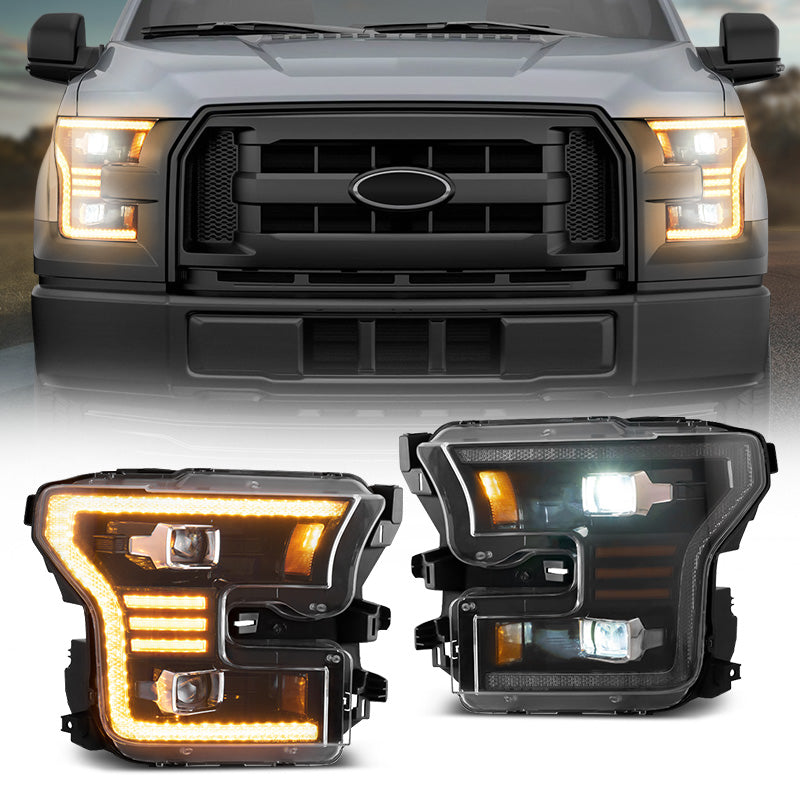
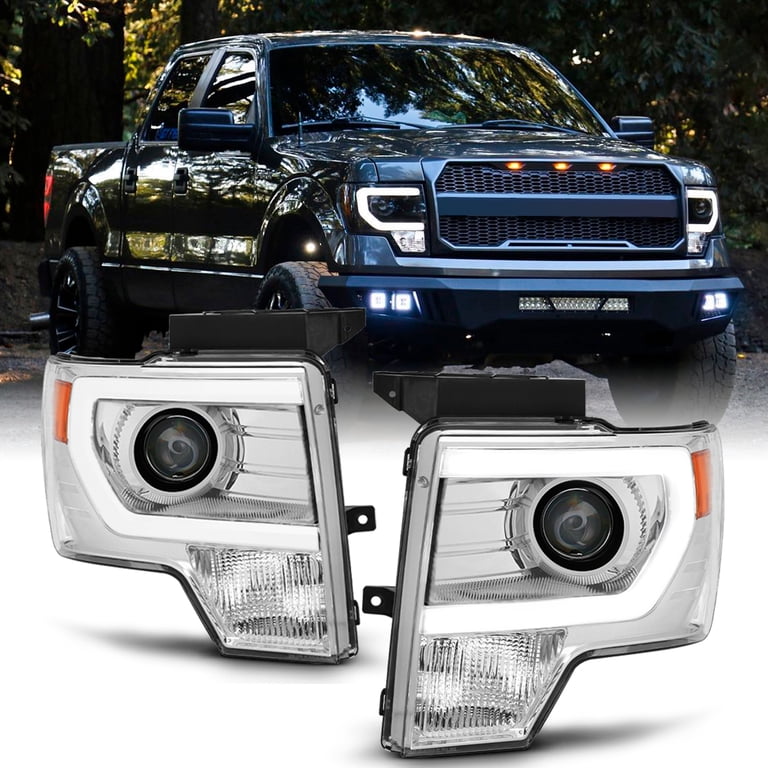
New Headlight Style for Ford F-150
Modern vehicles now leave the factory with LED headlights. However, before automakers offered that option, drivers upgraded halogen systems with HID or LED conversion kits.
Why? Because they wanted more light.
So we decided to compare three setups on a 2015–2017 Ford F-150:
-
OEM halogen reflector headlights
-
OEM Ford LED module headlights
-
Aftermarket S-V.3 LED headlight bulbs
We tested all three in a controlled environment. The results surprised us.
Understanding Lux vs Lumens
First, let’s clarify something important.
Lumens measure total light output. Lux measures light intensity at a specific point. In other words, lumens tell you how much light a bulb creates. Lux tells you how much usable light hits the road.
Therefore, lux gives a more realistic performance comparison.
We positioned each truck 30 feet from a wall. Then we used a digital light meter to find the brightest point in each beam pattern.
Test Results at 30 Feet
OEM Halogen Reflector (H11)
The factory halogen reflector performed respectably. Although the color looked warm, the beam pattern stayed consistent.
OEM Ford LED Module
Surprisingly, the factory LED module produced slightly less lux than the halogen reflector. While it delivered a modern white color, it did not outperform the halogen setup in raw intensity.
S-V.3 LED Headlight Bulbs (H11)
When we installed the S-V.3 LED bulbs in the reflector housing, the output jumped dramatically. In fact, they produced roughly 50% more lux than either factory option.
That result caught our attention.
Side-by-Side Comparison
| Setup |
Measured Lux @ 30 ft |
| OEM Halogen Reflector |
608 lux |
| OEM Ford LED Module |
590 lux |
| S-V.3 LED Bulb |
905 lux |
Not only did the S-V.3 outperform both factory systems, but it also delivered a stronger hotspot without excessive scatter.
What Does This Mean?
First, factory LED does not always guarantee superior performance. In this case, the halogen reflector actually edged out the OEM LED module.
Second, proper aftermarket LED technology can significantly increase usable light output. However, beam pattern control still matters. You must choose a well-designed LED bulb to avoid glare.
Finally, testing in controlled conditions removes guesswork. Instead of relying on lumen claims, measuring lux reveals real-world performance.
Important Legal Information
Street legal in the USA for fog light use only.
Not compliant with DOT / FMVSS108 and not street legal in the USA for headlight use.
Certain specialty vehicles limited to off-street use and without DOT registration may use these products off-road only.
International street legality varies by country.
This regulation applies to all LED and HID bulbs installed in halogen headlight housings, regardless of brand or marketing claims.
Upgrading headlights requires careful research. While factory LED systems look impressive, performance numbers tell the full story. Always evaluate beam pattern and lux output before making a decision.